
Why settle for a rigid booth that only fits one floor plan when you could own a display that evolves with your brand? Most exhibitors struggle with high drayage costs and dim displays that fail to grab attention. You deserve a setup that works for you, not against you. Transitioning to a modular light box system allows you to trade logistical nightmares for a high-impact, scalable branding asset.
We understand the pressure of the trade show floor. You need a professional presence that looks high-end but remains easy to manage. This guide will show you how to leverage the latest 2026 display innovations to cut your setup time to under 30 minutes. You’ll learn how to choose UL-certified components and energy-efficient LEDs rated for over 50,000 hours of brilliance. From 10×10 setups to 10×20 configurations, discover how to build a flexible display strategy that grows alongside your business.
Key Takeaways
- Learn how a modular light box system uses tool-free aluminum frames to replace heavy, outdated custom booths.
- Discover why SEG fabric technology creates a seamless, frameless look that makes your graphics pop with professional vibrancy.
- Master the art of booth expansion by using a single framework to fit both 10×10 and 10×20 floor plans effortlessly.
- Slash your event expenses by choosing lightweight materials that significantly reduce shipping and drayage fees compared to wood builds.
- Elevate your brand presence with high-impact, backlit displays designed for rapid assembly and maximum visibility.
Table of Contents
- What is a Modular Light Box System? Defining the 2026 Standard
- The Anatomy of High-Impact Modular Displays
- Scalability: Reconfiguring Your Booth for Any Event Space
- Logistics and ROI: The Hidden Value of Modular Systems
- Designing Your High-Impact Presence with Mobile Light Box
What is a Modular Light Box System? Defining the 2026 Standard
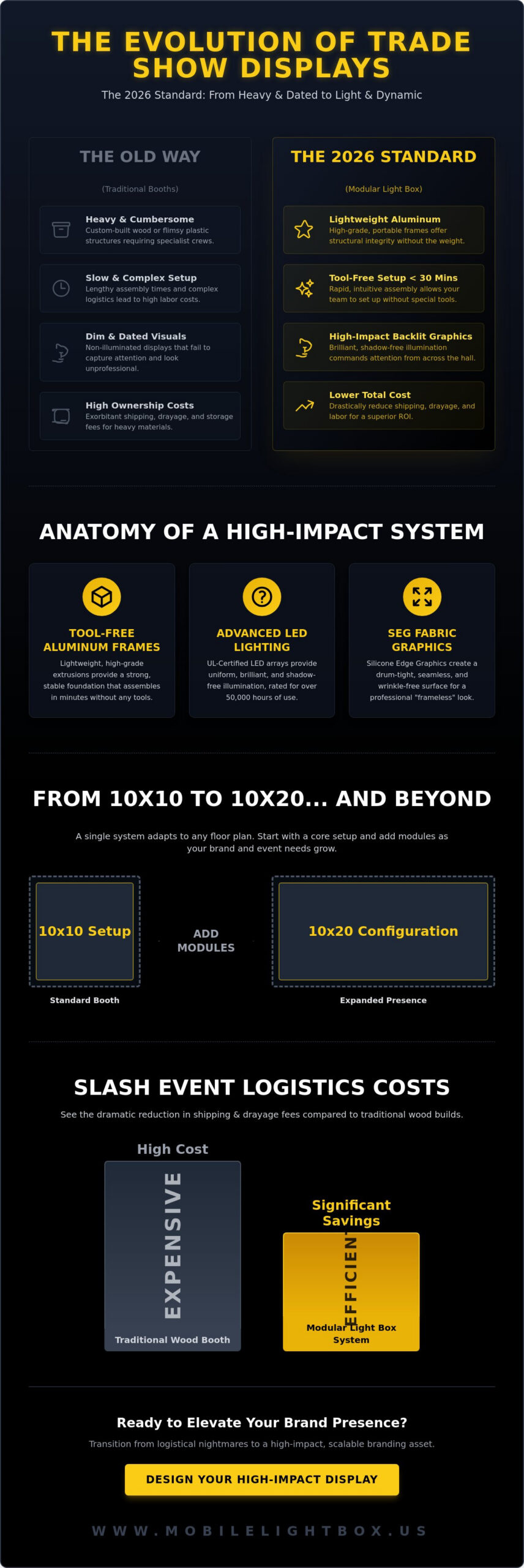
A modular light box system is an interconnected framework of illuminated frames designed for rapid assembly and infinite scalability. It’s a departure from the static, heavy displays of the past. Traditionally, high-end trade show presences required custom-built wooden booths. These setups were expensive to build, heavy to ship, and required specialist crews to assemble. The 2026 industry standard has shifted toward lightweight, tool-free aluminum systems that provide the same architectural impact without the logistical baggage.
To better understand how these configurations come together in a real-world environment, watch this helpful video:
While many exhibitors still rely on traditional pop-up displays, those systems often lack the durability and aesthetic polish required for a modern professional brand. Pop-ups typically use thin plastic lattices that can feel flimsy and look dated under harsh convention center lights. In contrast, a modular light box system uses high-grade aluminum extrusions that offer structural integrity and a premium, “frameless” appearance. You get crisp, clean lines and a vibrant glow that commands attention from across the hall.
The “Modular” Difference: Why it Matters for Your Brand
Modularity is about growth and adaptability. It allows you to swap individual frames or add new sections as your marketing needs evolve. This flexibility helps you future-proof your trade show assets; you don’t have to buy a completely new booth every time your floor space changes. Understanding what is a light box display is the first step in realizing how these units function as versatile marketing tools. You can use a single unit for a retail pop-up or connect ten units to create a massive, immersive event wall.
Key Components of a Professional System
A professional modular mobile light box relies on three core pillars: advanced lighting, structural engineering, and high-fidelity graphics. Internal LED arrays are the heart of the system, providing uniform illumination that eliminates shadows. This design utilizes the core principles of backlighting to separate your brand imagery from the background, making it pop. High-grade aluminum extrusions provide the strength needed for large-scale installations while remaining light enough for one person to carry. Safety is also critical. Every professional system should use UL-certified electronics to ensure compliance with strict venue fire codes and electrical standards.
The Anatomy of High-Impact Modular Displays
Modern high-impact displays aren’t just about light; they’re about the precision of the hardware. A modular light box system relies on a synergy between tension fabric and advanced optics. This combination creates a professional, high-end presence that commands attention. While some competitors focus on simple magnetic connectors, the true differentiator lies in the graphic interface and the lighting distribution across the frame.
The backbone of this visual quality is the SEG fabric light box technology. SEG stands for Silicone Edge Graphics. It involves a thin silicone strip sewn directly into the edge of a dye-sublimated fabric graphic. This strip gets pressed into a recessed groove on the aluminum frame. The result is a drum-tight, wrinkle-free surface that looks like a solid panel. Because the fabric wraps all the way to the edge, it creates a “frameless” look. This aesthetic is essential for maintaining a clean, modern brand image.
Vibrancy comes from dye-sublimation printing. Unlike traditional inkjet methods, dye-sublimation infuses the ink into the fibers of the tension fabric. This prevents cracking and ensures the colors remain saturated even when backlit. This approach aligns with academic research on modular theory which suggests that standardized components should not sacrifice visual communication power. If you need to change your marketing message, SEG graphics allow for 2-minute visual updates without any specialized tools.
Lighting choice also dictates visual depth. Edge-lit configurations use LEDs mounted on the inner perimeter of the frame. They’re excellent for portability and thinner profiles. Back-lit configurations place LED arrays directly behind the graphic on a ladder-like structure. This setup provides superior visual depth and eliminates “hot spots” in larger displays. For exhibitors with island or peninsula layouts, double-sided illuminated displays are a game-changer. They ensure your brand is visible from every angle of the show floor. You can browse professional booth kits to see how these different configurations impact your floor plan.
Silicone Edge Graphics (SEG): The Professional Edge
Installation is straightforward. You press the silicone strip into the frame groove by hand. It creates a drum-tight, wrinkle-free surface every time. This tension ensures that the graphic remains perfectly flat regardless of humidity or temperature. SEG graphics allow for 2-minute visual updates, making them perfect for rapid messaging changes between show days.
Advanced LED Integration and Power Management
The industry has moved toward pre-installed LED strips for faster setup. You don’t want to spend time wiring your booth. Modern systems use “plug-and-play” magnetic connectors that join power across frame sections automatically. This tool-free logistical advantage is a primary reason why exhibitors are moving away from traditional builds. Heat dissipation is also critical. In 2026, LED modules feature integrated heat sinks that keep the system cool during long exhibition hours. This protects the fabric from heat damage and ensures the LEDs reach their full 50,000-hour lifespan.
Scalability: Reconfiguring Your Booth for Any Event Space
Growth shouldn’t require a complete overhaul of your exhibition assets. A modular light box system provides the structural flexibility to adapt as your business expands. Many companies start with a standard 10ft backwall but soon find themselves booking larger 20ft spaces. Instead of purchasing a separate kit, you simply add compatible frames to your existing inventory. This scalability ensures that your initial investment remains relevant for years.
Between major events, these units don’t need to sit in storage. You can deploy individual frames as standalone displays in your corporate lobby or at smaller local recruitment fairs. This versatility maximizes your ROI and keeps your brand visible year-round. Use the same frames to create a massive wall one week and three separate kiosks the next.
Choosing a modular mobile light box system offers distinct advantages for growing brands:
- Seamless Expansion: Connect additional frames to double or triple your booth size in minutes.
- Configuration Variety: Use 90-degree connectors to build “L” or “U” shaped walls for corner booths.
- Logistical Efficiency: Smaller frame segments fit into standard shipping cases, reducing freight costs.
- Message Targeting: Swap specific fabric panels to tailor your message for different industry niches.
- Structural Integrity: Maintain a rigid, professional look even when spanning large 20ft footprints.
From 10×10 to 10×20: A Growth Blueprint
Expand your presence without the headache of custom fabrication. The MLB 300×240 Bundle serves as a perfect starting point for companies moving into larger spaces. It provides the height and width needed for high-impact branding while remaining fully compatible with smaller frame components. By adding frames rather than replacing them, you reduce waste and lower your total cost of ownership over the product’s lifespan. This “building block” approach is the most efficient way to manage a busy event calendar.
Creative Layouts: Beyond the Backwall
Don’t limit yourself to flat walls. Use verticality to stand out. Integrating illuminated towers adds a 3D element that captures attention from high-traffic aisles. These towers act as beacons, guiding visitors toward your space. You can also incorporate backlit counters to create a cohesive, professional reception area. Using bridge headers and angled connectors allows you to build immersive environments that feel like a permanent installation but pack down into portable cases. This architectural approach transforms your booth into a destination rather than just a backdrop.
Logistics and ROI: The Hidden Value of Modular Systems
Exhibitors often ask why they shouldn’t just invest in a custom wood build. While wood offers a high level of customization, it functions as a logistical anchor. Custom booths are heavy, require specialized freight, and often suffer damage during transit. Transitioning to a modular light box system replaces that bulk with high-grade, lightweight aluminum. This shift directly impacts your bottom line by slashing drayage fees and shipping expenses. In fact, industry data from June 2026 indicates that drayage for these systems typically costs between $50 and $150 per show, a fraction of the cost associated with traditional crates.
Labor is another silent budget killer. Traditional booths require a dedicated Installation and Dismantle (I&D) crew, often billing for several hours. A modular approach leverages a tool-free assembly strategy that allows one person to finish the setup in under 30 minutes. You don’t need a toolbox or a specialist team. This ease of use ensures your staff stays focused on leads rather than hardware. If you’re ready to stop overpaying for logistics, explore our professional booth kits designed for rapid deployment.
Portable Protection: Shipping and Storage
Modern systems prioritize mobility. Your investment travels in wheeled, foam-lined shipping cases that protect the aluminum extrusions and LED components. Because these systems pack down so efficiently, you can often ship them via standard carriers like UPS or FedEx instead of expensive LTL freight. This portability reduces shipping costs, which typically range from $150 to $500 depending on the booth size. To ensure your system lasts for years, you can easily source spare parts like connectors or replacement feet. This accessibility extends the life of your hardware far beyond a single season.
Calculating the Total Cost of Ownership
Don’t just look at the initial purchase price; consider the Total Cost of Ownership (TCO). Custom builds are often “one-and-done” assets that require expensive modifications for different floor plans. Modular systems are inherently reusable. For exhibitors attending six or more shows per year, investing in a modular setup can result in a TCO that’s 40-60% lower than purchasing separate displays for each space.
The ability to swap graphics also provides a strategic marketing edge. You can perform rapid A/B testing of your messaging by simply ordering new SEG panels for different shows. This flexibility keeps your brand fresh without requiring a new hardware investment. A 10-minute setup by one person saves hundreds in I&D labor every single time you hit the show floor. It’s an efficient, solution-oriented way to manage a high-pressure event calendar while maintaining a premium brand presence.
Designing Your High-Impact Presence with Mobile Light Box
The partnership with Mobile Light Box is built on a single promise: High-Impact, Low-Stress. We understand that the trade show floor is a high-pressure environment where every second of visibility counts. A modular light box system from our collection does more than just fill a 10×10 space; it actively enhances your professional image. By combining the sleek aesthetics of backlit SEG technology with the portability of aluminum frames, we provide hardware that works as hard as your sales team. You can browse our pre-configured kits to find a solution that balances visual power with logistical ease. Our systems are designed for the modern exhibitor who values both high-end aesthetics and extreme portability.
Our approach is fundamentally results-oriented. We’ve eliminated the frustration of complex setups and heavy crates, replacing them with organized, professional systems that anyone can assemble. This efficiency allows you to focus on what matters most: connecting with your audience and growing your business. By positioning your brand behind a wall of light, you create an inviting atmosphere that naturally draws visitors into your space. Our hardware doesn’t just function as a backdrop; it acts as a vibrant extension of your brand’s personality.
Choosing Your Starting Point
Selecting your first booth kit is the foundation of your long-term display strategy. Many of our clients find that starting with a 10ft kit provides the perfect balance of impact and versatility. You aren’t locked into a single layout. You can add new modules, towers, or counters later as your budget and booth size increase. This “start small, scale fast” mentality is exactly what modern businesses need to stay agile. If you need to supplement your illuminated backwall, we offer high-quality banners that maintain your brand’s professional look while remaining extremely portable. These non-illuminated options are perfect for side-walls or highlighting specific product features within a larger booth footprint.
Next Steps: From Concept to Show Floor
Ordering your system is a streamlined process. Once you’ve selected your frames, the graphic submission is handled through a simple, user-friendly workflow. Our team serves as your practical innovator, guiding you through the technical requirements to ensure your final display is crisp and vibrant. We don’t just ship equipment; we provide the support necessary to move from concept to show floor without the typical stress associated with trade show logistics. Your hardware arrives organized and ready for action. We ensure every connector, LED strip, and fabric panel meets our rigorous standards for quality and ease of setup. This commitment to excellence ensures that when you arrive at the venue, your only task is to flip the switch and let your brand shine.
Explore our modular light box shop and start building your system today.
Elevate Your Professional Presence for 2026
Your brand deserves more than a static backdrop. It needs a dynamic asset that scales as fast as your business does. By choosing a modular light box system, you’re investing in a future-proof display strategy that eliminates the stress of traditional trade show logistics. You’ve seen how these systems transform shipping headaches into streamlined operations while delivering the high-vibrancy visuals your audience expects.
The shift toward efficiency doesn’t mean sacrificing quality. Our hardware features durable aluminum frames and UL-certified LEDs that ensure safety and longevity in any venue. You can achieve a professional, high-end look with high-vibrancy SEG fabric graphics that stay drum-tight through every event. Most importantly, the tool-free assembly allows for 10-minute setups, giving your team more time to engage with potential clients. This transition from complex hardware to a solution-oriented display strategy ensures your professional presence is always high-impact and low-stress.
Ready to transform your next event? Shop Modular Light Box Systems & Booth Kits and discover the power of high-impact branding. It’s time to build a presence that truly reflects your brand’s innovation.
Frequently Asked Questions
How long does it take to set up a 10ft modular light box system?
Setting up a 10ft modular light box system typically takes under 30 minutes for a single person. The process is designed for maximum speed and logistical efficiency. Most components utilize tool-free connectors that slide into place with minimal effort. This rapid assembly ensures you spend your time networking rather than struggling with hardware. It’s a low-stress solution for busy professionals who need to manage tight event schedules without extra labor costs.
Do I need any tools to assemble a modular light box?
You don’t need any tools to assemble your display. Every connection point uses intuitive thumb-screws or magnetic locking mechanisms. This design eliminates the need for screwdrivers or specialized wrenches on the show floor. It also prevents the risk of losing small hardware during a hectic setup. Simply unpack the frame sections and snap them together to create a rigid, professional structure in minutes. It’s efficient, organized, and reliable.
Can I update the graphics on my modular system without buying new frames?
Updating your visuals is simple and cost-effective. You can order replacement SEG fabric graphics at any time without needing to purchase new aluminum frames. This flexibility allows you to tailor your message for different industry events or product launches. Just pull the existing silicone edge from the frame groove and press the new graphic into place. It’s an efficient way to keep your branding fresh and your marketing message targeted.
What happens if an LED light goes out in my modular display?
Modern LEDs are built for extreme longevity. They’re rated for over 50,000 hours of continuous use. If a component does fail, the modular design allows for easy replacement of individual LED strips. You don’t have to replace the entire frame. We offer spare parts to ensure your display remains fully functional for years. This reliability is a key part of our results-oriented hardware promise, ensuring your brand stays illuminated throughout the show.
Are modular light box systems compatible with standard trade show power outlets?
Yes, these systems are fully compatible with standard trade show electrical setups. Most modular light box models operate on a standard 110V connection found in every convention center. For safety compliance, our electronics are UL-certified. This certification is mandatory in venues that require NFPA 701 fire-resistance standards. You can plug in and illuminate your booth immediately without needing specialized transformers or adapters. It’s a plug-and-play solution for high-impact visibility.
How do I pack a modular light box for shipping?
Packing is straightforward and secure. Use the wheeled, foam-lined shipping cases provided with your kit to protect the aluminum extrusions and lighting components. Each piece has a dedicated slot to prevent shifting during transit. This organized approach ensures your display arrives in perfect condition. Because the system packs down into compact sections, you can often ship via standard carriers like UPS or FedEx to save on expensive freight costs.
Can I use my modular light box as a double-sided display?
You can certainly use your display as a double-sided asset. Many of our frames are designed for double-sided illuminated graphics. This configuration is ideal for island or peninsula booth layouts where traffic approaches from multiple directions. You simply install a backlit SEG graphic on both the front and back of the frame. It maximizes your brand visibility without increasing your booth’s physical footprint on the floor. It’s a high-impact branding strategy.
What is the difference between a modular light box and a pop-up display?
A modular light box system offers a significant upgrade over traditional pop-up displays in both durability and aesthetics. While pop-ups use thin plastic lattices, modular systems utilize high-grade aluminum extrusions for a rigid, high-end feel. The SEG fabric provides a frameless look that pop-ups can’t replicate. Additionally, modularity allows you to scale and reconfigure your booth for different space sizes, providing a long-term display strategy that grows with your business.
