
Every year, marketing teams invest thousands of dollars in trade show booths, conference backdrops, recruiting displays, product launch graphics, retail activations, and branded event signage.
The problem isn’t necessarily the cost of each display. It’s that most display systems are designed for a single purpose.
A backdrop ordered for a spring product launch may never be used again. A recruiting display created for a career fair often ends up in storage. Event graphics are frequently treated as short-term purchases rather than long-term assets.
As organizations attend more events, the result is predictable:
- More displays to store
- More graphics to manage
- More hardware to purchase
- More waste generated over time
Forward-thinking marketers are beginning to rethink this approach.
Instead of buying signage for individual events, they’re investing in reusable event infrastructure that can support years of campaigns, activations, and exhibitions.
The Hidden Cost of Disposable Signage
Most companies don’t set out to create a collection of mismatched displays.
It happens gradually.
A 10-foot backdrop is purchased for a regional trade show.
A larger display is purchased the following year for a national conference.
A separate setup is created for recruiting events.
Additional graphics are ordered for customer conferences, dealer meetings, and product launches.
Before long, marketing teams are managing multiple display systems that perform essentially the same function. While each purchase may have made sense at the time, the cumulative cost becomes substantial. More importantly, the lack of flexibility creates operational challenges that impact budgets, logistics, and efficiency.
Buy Infrastructure, Not Signage
The most successful event programs treat display hardware differently.
Instead of viewing displays as campaign-specific purchases, they view them as infrastructure.
The hardware remains constant.
The messaging changes.
This approach separates the long-term investment—the frame—from the short-term marketing campaign—the graphics.
A modular backlit display system allows organizations to:
- Reuse hardware across multiple events
- Update graphics as campaigns evolve
- Adapt to different booth sizes
- Maintain brand consistency
- Reduce long-term display costs
Rather than purchasing a new display every time marketing objectives change, organizations simply refresh the graphics while continuing to leverage the same display structure.
One Frame. Five Configurations.
One of the biggest challenges exhibitors face is adapting to different event footprints.
A 20-foot booth at a national trade show may become a 10-foot booth at a regional event.
Traditional display systems often require entirely different hardware for each scenario.
The Mobile Light Box MLB-600 series was designed to solve this problem.
While marketed as a 20-foot backlit display, the same hardware can be assembled in five different widths simply by omitting frame sections.
Width Configurations
One Frame. Five Configurations.
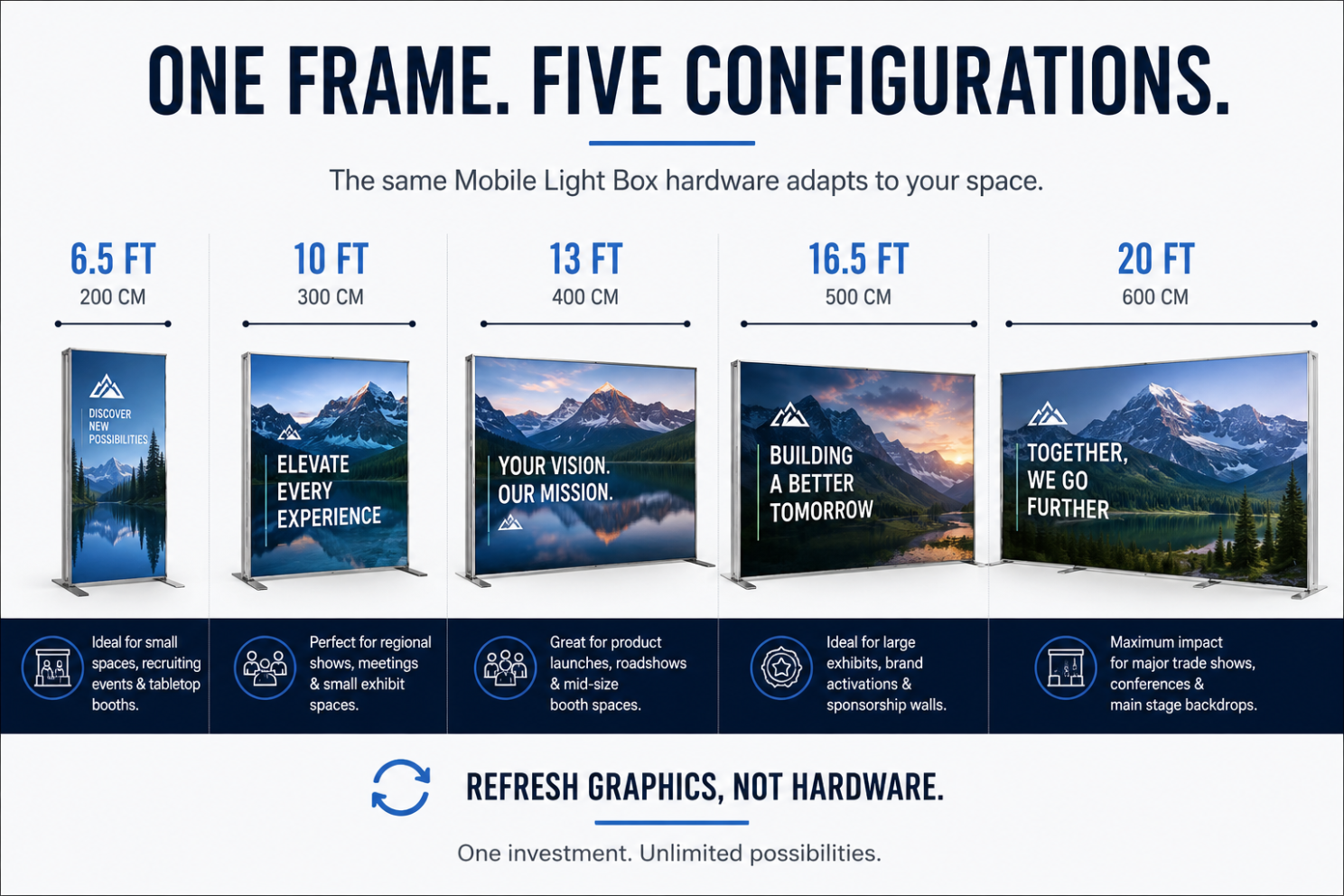
The same frame components are used throughout.
No additional hardware systems are required.
As event requirements change, exhibitors can reconfigure the display using the components they already own.
This flexibility allows one investment to serve multiple event environments throughout the year.
Scale Upward, Too
Flexibility isn’t limited to width.
Mobile Light Box also offers vertical extension kits that allow users to increase the height of their displays.
For example, a standard 20 ft x 8 ft display can be converted into a 20 ft x 10 ft display while maintaining the same modular design principles.
The extension system can be applied across the different width configurations, allowing exhibitors to adapt both horizontally and vertically depending on event requirements.
Instead of replacing a display system when larger branding opportunities arise, organizations can expand what they already own.
Supporting an Entire Year of Marketing Campaigns
Imagine a typical annual marketing calendar.
Q1: Product Launch
The full 20-foot display is assembled to maximize visibility at a major industry trade show.
New campaign graphics highlight product features and announcements.
Q2: Regional Roadshows
The display is reconfigured into a smaller format better suited for local venues and dealer events.
Graphics are updated to reflect regional messaging.
Q3: Recruiting Events
A compact version of the display supports university recruiting programs and hiring fairs.
Employer branding graphics replace product marketing content.
Q4: Customer Conference
The display returns to a larger footprint featuring customer success stories, new innovations, and executive messaging.
Throughout the year, the hardware remains the same.
Only the graphics change.
This is the difference between purchasing signage and building a visual platform.
Real-World Example: Event Infrastructure That Adapts to Every Client
The benefits of modularity are already being realized by organizations managing large event portfolios.
One Mobile Light Box customer in the event management industry has invested in approximately 30 modular backlit display systems.
Rather than purchasing custom hardware for every client activation, they use the same display infrastructure repeatedly across different events.
When customer requirements change, they simply update the graphics and reconfigure the frame to match the event footprint.
This gives them the flexibility to adapt quickly to client needs without continually investing in new display hardware.
The result is a more agile operation, simplified inventory management, and significantly greater utilization of existing assets.
For event professionals, this approach transforms displays from one-time expenses into reusable business infrastructure.
Refresh Graphics, Not Hardware
Campaigns change. Products evolve. Brand messaging gets updated.
That’s exactly why graphics should be flexible.
Mobile Light Box customers can order replacement SEG graphics in any supported width configuration at any time.
Rather than replacing the entire display system, they simply update the printed graphic to reflect current marketing objectives.
This creates a far more efficient lifecycle:
- Purchase the display hardware once.
- Reuse the frame for years.
- Refresh graphics whenever campaigns change.
For many organizations, this approach dramatically reduces long-term display spending while increasing marketing agility.
Why Backlit Displays Deliver Better Long-Term Value
If a display system is going to be reused for five to ten years, visual performance matters.
Backlit SEG graphics create a premium presentation that stands apart from traditional banner stands and printed backdrops.
Benefits include:
- Increased visibility on crowded show floors
- More vibrant graphic presentation
- Greater visual impact
- Consistent brand presentation
- Professional appearance across multiple campaigns
When combined with modularity, backlit displays become a long-term branding asset rather than a short-term event purchase.
Sustainability Through Reuse
Sustainability isn’t always about using different materials. Sometimes it’s about maximizing the value of materials already in service. A modular display system supports sustainability by extending the life of display hardware.
Instead of discarding complete displays every time marketing objectives change, organizations continue using the same frame structure while updating only the graphics.
With a hardware lifespan of approximately five to ten years, one display system can support dozens of campaigns throughout its lifecycle.
The most sustainable display often isn’t the newest display.
It’s the one you don’t have to replace.
Recommended Modular Display Packages
Looking to build your own reusable visual kit?
These Mobile Light Box frames provide the flexibility to support multiple event sizes and campaign requirements while maintaining a consistent hardware platform.
20 ft x 7.4 ft Backlit Display Package
Ideal for organizations seeking a lower-profile display while maintaining maximum width and modular flexibility.
MLB 600×225 – Graphic Package | 20ft x 7.4ft
20 ft x 8 ft Backlit Display Package
The most versatile configuration and the foundation for a scalable modular event infrastructure strategy.
MLB 600×240 – Graphic Package | 20ft x 7.87ft
20 ft x 8.2 ft Backlit Display Package
Provides additional visual height while maintaining all modular width configurations.
MLB 600×250 – Graphic Package | 20ft x 8.2ft
The Future of Event Marketing Is Modular
Marketing campaigns evolve. Booth sizes change. Customer expectations shift.
Your display system should be able to adapt alongside them.
Organizations that continue purchasing event-specific signage often find themselves managing growing inventories of displays that serve only one purpose.
Organizations that invest in modular event infrastructure gain something much more valuable:
Flexibility.
One frame.
Five configurations.
Years of campaigns.
Because the smartest display investment isn’t the one you use once.
It’s the one that keeps delivering value long after the first event is over.
